
Find Hawaii Property Records
Hawaii property records document ownership, deed transfers, liens, and recorded encumbrances on all real estate across the state. Hawaii is one of just two states in the country with a single statewide recording system. That means all documents go through the Bureau of Conveyances in Honolulu rather than separate county recorder offices. You can search property records online through the Bureau's RecordEASE portal or through each county's assessment and tax search systems. This guide covers where to find Hawaii property records, how the main search tools work, and what you should know about the state's unique recording structure.
Hawaii Property Records Overview
The Bureau of Conveyances
The Bureau of Conveyances is the central agency for all property records in Hawaii. Located at the Kalanimoku Building, 1151 Punchbowl St. #120, Honolulu, the bureau records, examines, and indexes more than 344,000 documents each year. Deeds, mortgages, leases, liens, and other instruments affecting real property from every part of the state come here. That is very different from most other states, where each county keeps its own recorder office. In Hawaii, you have one place to look for recorded documents no matter which island the property sits on.
The bureau manages two distinct systems. The Regular System covers most property in Hawaii and records documents in the order they arrive. The Land Court System applies to properties that have been registered with the court and carry a Certificate of Title. Land Court property has a separate chain of title that runs through the court system and offers stronger ownership protections. Both systems trace back to the Great Mahele of 1848, when Hawaii's modern land ownership structure was first established, dividing land among the crown, government, chiefs, and common people. Records from that era form the root of many title searches today.
The bureau's Public Reference Room is at Room 123 in the Kalanimoku Building, open Monday through Friday, 8:15 am to 4:15 pm, excluding state holidays. Documents recorded before 1976 require an in-person visit. From 1976 forward, the RecordEASE online portal gives you access without traveling to Honolulu. Contact the bureau at (808) 587-0147 or by email at dlnr.bc.faq@hawaii.gov.
The official Bureau of Conveyances website provides details on recording requirements, fee schedules set by statute, and a link to the RecordEASE login portal.
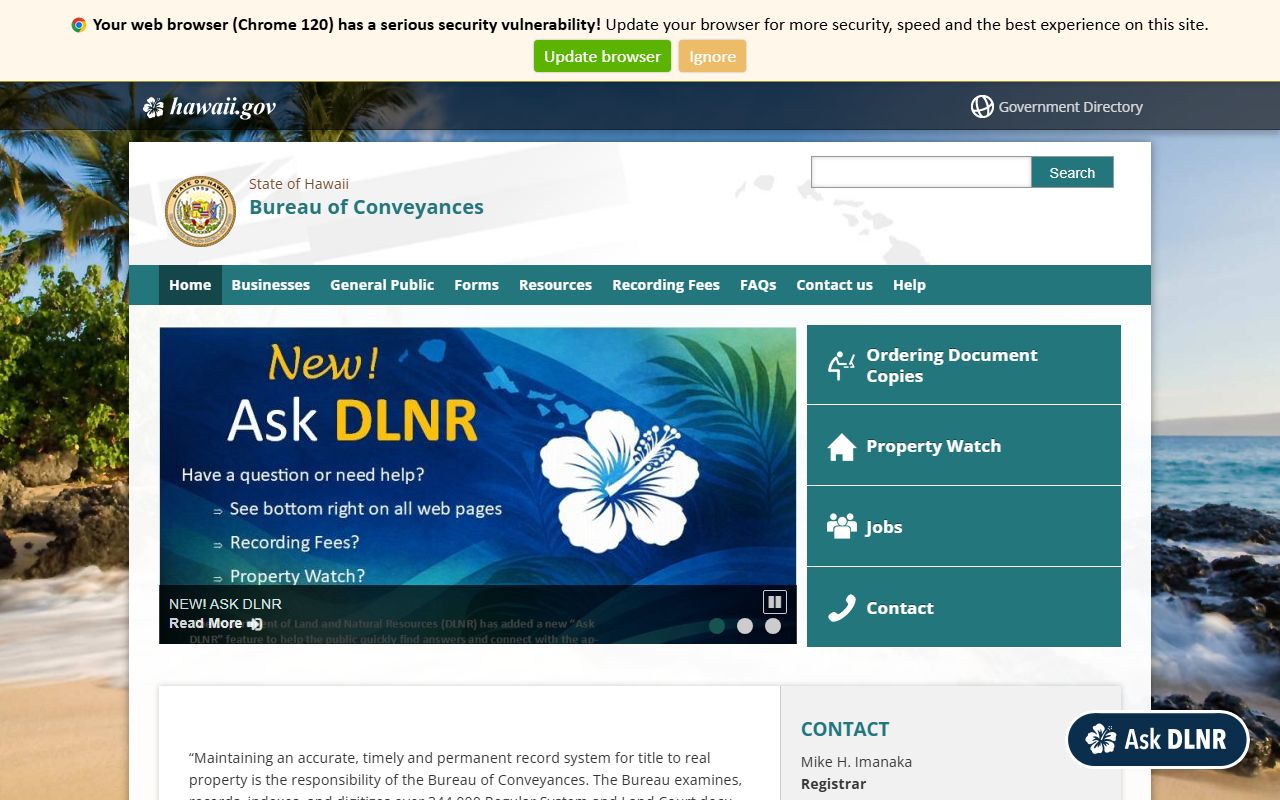
The bureau serves as the single statewide repository for all recorded instruments affecting real property. It handles deeds, mortgages, leases, liens, and land court filings from every county.
How to Search Hawaii Property Records Online
The Bureau of Conveyances runs RecordEASE, the official portal for searching and purchasing recorded property documents. All documents from 1976 forward are available here. Creating an account is free. Your email address becomes your username. Search functions include grantor and grantee name, Tax Map Key (TMK) in format 1-1-1-111-111, Transfer Certificate of Title number, document number, and date ranges. Documents appear with a "Preview" watermark before you buy them. Credit card users pay $1 per page. A monthly subscription runs $50 per month plus $3 per document, or $1,000 per month for unlimited access. The system does not store credit card data, so you enter your card each time. Use Google Chrome or Firefox and turn off pop-up blockers.
The RecordEASE web access system is where you search for recorded deeds, mortgages, and liens on Hawaii properties. New users click the "Daily Purchases, Non-Subscriber Account" link to register.
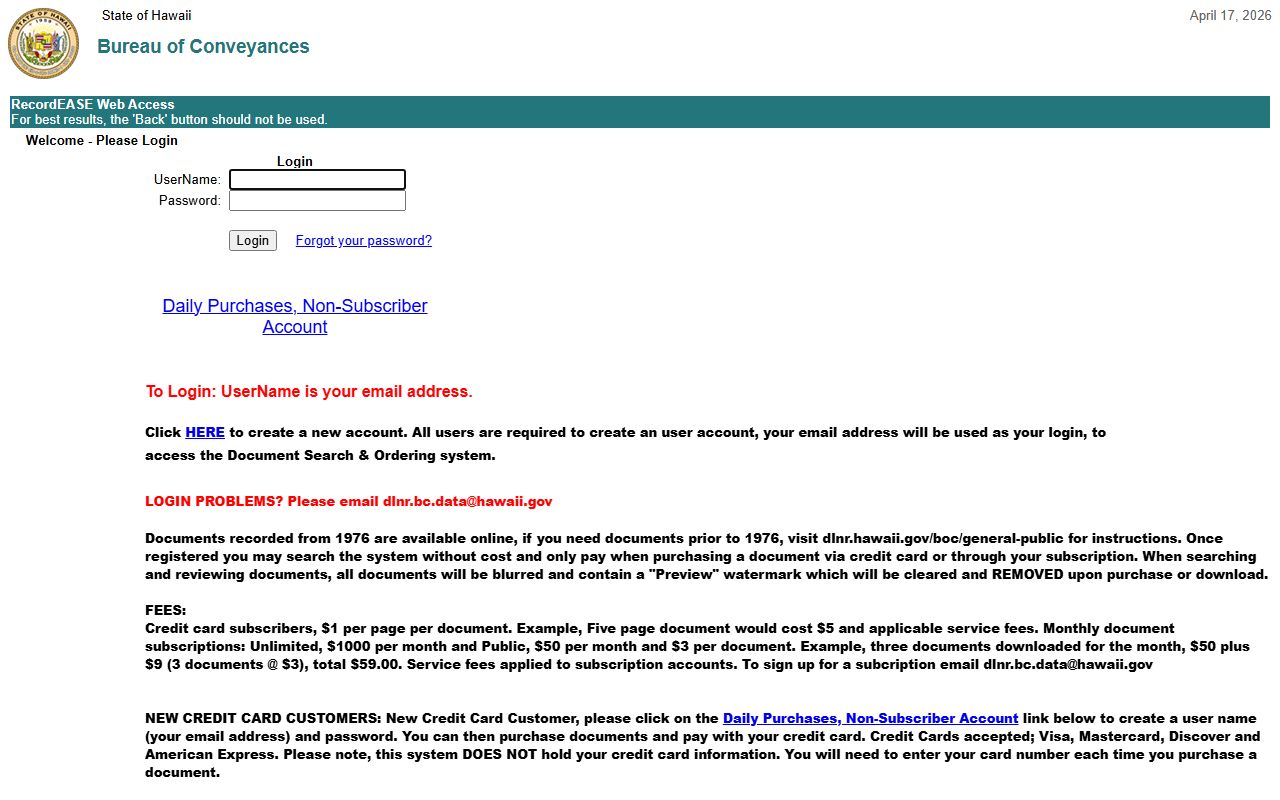
All documents show a "Preview" watermark until purchased. The preferred browsers are Chrome and Firefox. Turn off pop-up blockers before searching to avoid display issues.
Note: Documents recorded before 1976 are not available in RecordEASE. For older records, contact the Bureau of Conveyances Public Reference Room at Room 123, Kalanimoku Building, Honolulu, during normal business hours.
County Property Tax Records in Hawaii
Each county in Hawaii maintains its own real property assessment and tax records. These are separate from what the Bureau of Conveyances holds. County records show assessed values, tax classifications, ownership data, payment history, exemptions, and property characteristics. They update more often than recorded documents and are free to search. You need these records when checking how a property is classified for tax purposes, verifying exemptions are in place, or looking at prior ownership details and assessed value history.
Honolulu County operates the Real Property Assessment Division (RPAD) with offices at 842 Bethel Street in downtown Honolulu and at 1000 Ulu`ohi`a Street in Kapolei. The division employs 111 permanent staff across four branches and values all properties in the county every year using mass appraisal methods. Data updates weekly at the Honolulu County property search portal. A GIS mapping tool at the Honolulu parcel search system shows property boundaries and zoning. The division also offers a full suite of online services at realproperty.honolulu.gov, including home exemption filing and assessment appeals. Phone: (808) 768-3799.
Maui County's Real Property Assessment Division is at 70 E. Kaahumanu Avenue, Suite A-16, Kahului. Phone: (808) 270-7297. Email: RPA@co.maui.hi.us. Records search at the Maui County qPublic portal. Kauai County's assessment office is at 4444 Rice Street, Suite 454, Lihue. Phone: (808) 241-4224. Their public record search is at the Kauai County property tax site. Hawaii County (Big Island) has offices in Hilo at 101 Pauahi Street, Suite 4 (phone: 808-961-8201) and in Kailua-Kona at 74-5044 Ane Keohokalole Highway, Building D, 2nd Floor (phone: 808-323-4880). The county's resource hub at hawaiipropertytax.com covers forms, exemptions, and property search functions.
The Honolulu County GIS parcel search provides interactive maps and assessment data for all properties on Oahu. Data updates weekly.
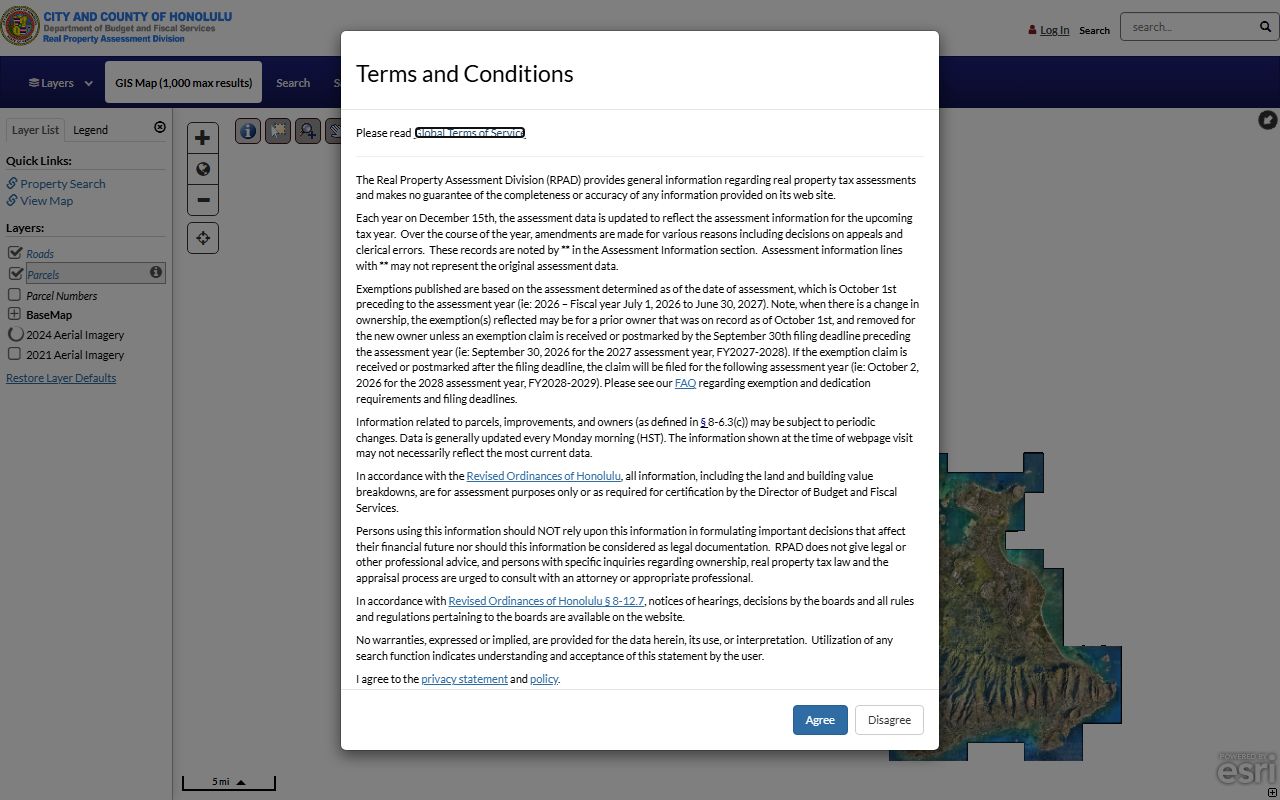
Assessed values in this system post annually once they are certified by the Director of Finance. Property characteristic data updates upon the annual assessment notice mailing.
Court Records and Property Liens
The Hawaii State Judiciary provides access to court records through eCourt Kokua, available at courts.state.hi.us. For property research, this system helps you find judgment liens, foreclosure actions, and disputes over real property. The system covers all circuit courts, including the First Circuit (Oahu), Second Circuit (Maui, Molokai, and Lanai), Third Circuit (Hawaii Island), and Fifth Circuit (Kalawao). Land Court cases are particularly important here. Registered property and Certificate of Title issues appear in the land court records, which are distinct from the Regular System at the Bureau of Conveyances.
You can search by party name, case number, or filing date. Registration is required for full document access. Case summaries, scheduled hearings, and filed documents are visible once you create an account. A judgment lien found through eCourt affects real property just like a recorded mortgage does. Checking both the Bureau of Conveyances system and court records gives you a complete picture of any encumbrances on a property.
The Hawaii State Judiciary eCourt Kokua system provides online access to civil, criminal, family, and land court records affecting property across all circuits.
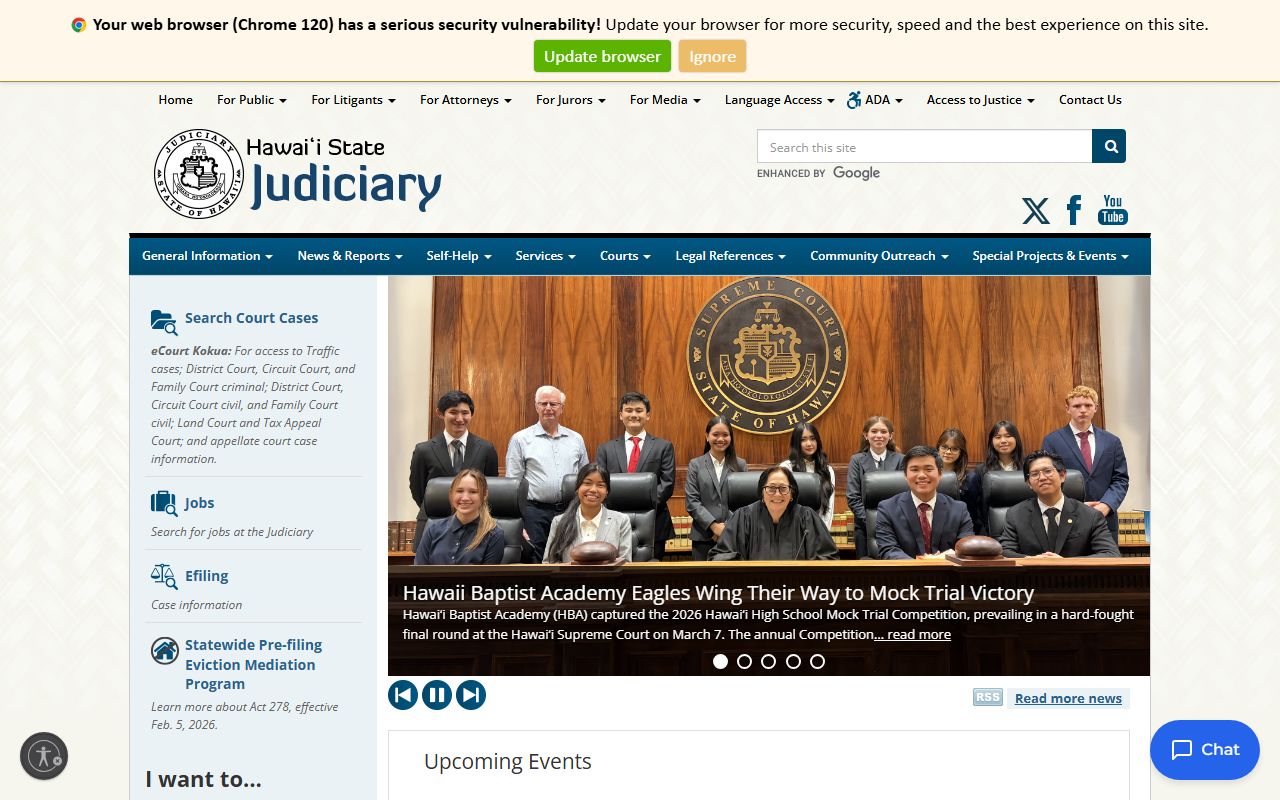
Land Court filings in this system are especially useful when researching registered property. Certificates of Title issued through the Land Court provide stronger ownership protections than Regular System recordings.
Hawaii Property Recording Laws
All property recording in Hawaii is governed by Hawaii Revised Statutes Chapter 502. The full statutory text is also compiled at law.onecle.com. Section 502-83 is the key provision. It states that any deed, lease for more than one year, mortgage, or other conveyance that is not recorded at the Bureau of Conveyances is void against any later purchaser who buys in good faith, pays value, and records first. This is why recording promptly matters. If you receive a deed but don't record it, a second buyer who records before you could take priority over your claim.
Section 502-31 sets the formatting rules for all recorded documents. The top 3.5 inches of the first page must be left for recording information. Pages must be 8.5 by 11 inches and single-sided. Documents must be stapled once in the upper left corner with no cover or backer attached. All signer names must be typed or stamped under each signature. These standards apply to every document submitted for recording, whether it is a deed, mortgage, or lien release.
Section 502-101 allows Hawaii residents who are veterans to record their honorable discharge certificate or other separation documents at the Bureau of Conveyances at no charge. Section 502-94 provides for translation of Hawaiian-language instruments into English by qualified translators, with translations recorded alongside the originals.
The Hawaii State Legislature tracks current property-related bills. HB1719 (2026) addresses manufactured housing as real property for purposes of transfer, mortgage, and lien, which matters for owners of manufactured homes who want to secure financing or record title.
Hawaii Revised Statutes Chapter 502 governs all recording requirements at the Bureau of Conveyances, including document formatting, fees, and the race-notice rule that protects recorded interests.
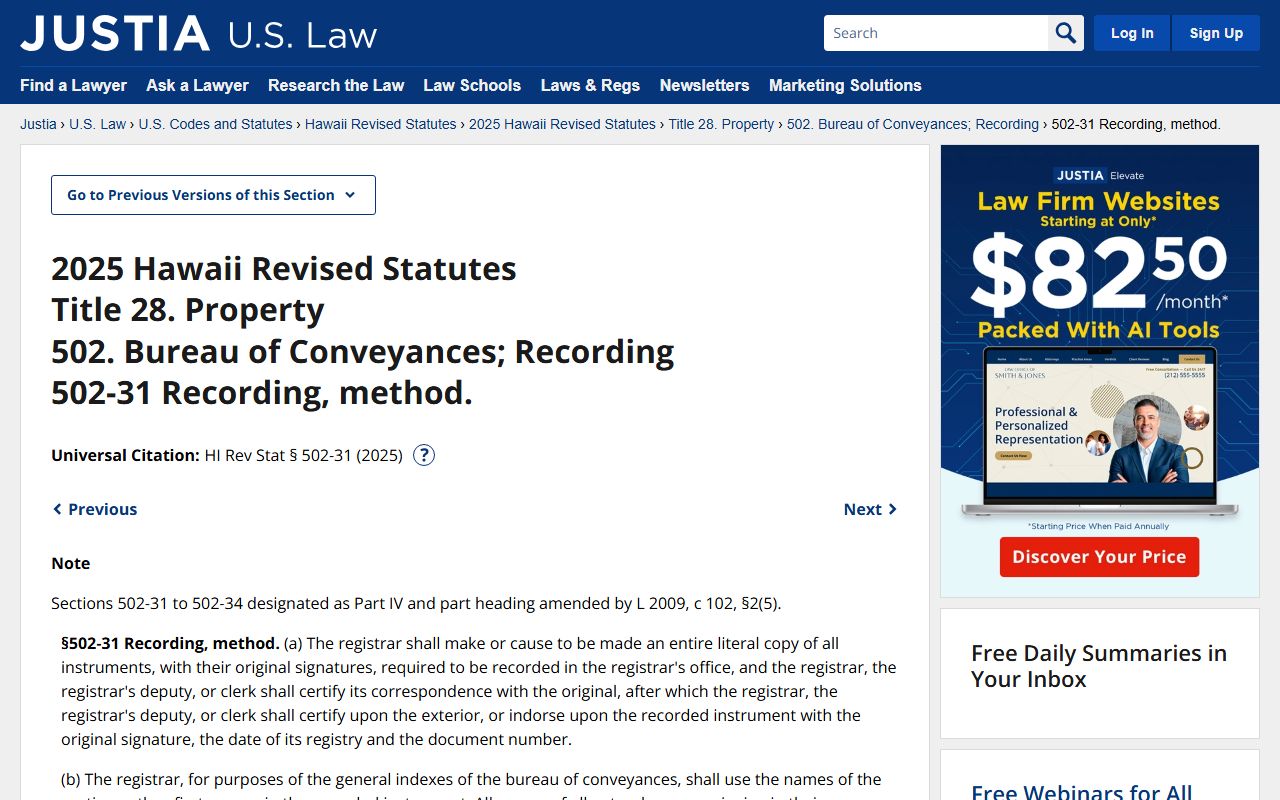
Section 502-83's race-notice rule makes prompt recording essential. An unrecorded deed is at risk from any later buyer or lender who records first without knowledge of the prior transfer.
Tax Records and HARPTA Withholding
The Hawaii Department of Taxation at tax.hawaii.gov handles state income tax matters tied to real property. One rule that affects many transactions is HARPTA, the Hawaii Real Property Tax Law. HARPTA is not a tax by itself. It is a withholding requirement. When a non-resident of Hawaii sells property in the state, the buyer or escrow company must withhold 7.25% of the sales price and send it to the state as a prepayment against potential capital gains tax. Sellers who are not prepared for this can face significant cash flow issues at closing.
Exemptions from HARPTA withholding apply in several situations: the seller is a Hawaii resident; the total gain on the sale is $300,000 or less; or the property was used as the seller's principal residence for at least two of the five years before the sale. Sellers who believe the withheld amount exceeds their actual tax liability can apply for a withholding certificate through the Department of Taxation before closing. Getting advice from a tax professional familiar with HARPTA before listing helps sellers avoid over-withholding and the wait for a state refund.
The Hawaii Department of Taxation website provides forms and guidance on HARPTA withholding requirements for non-resident property sellers.
Non-resident sellers should review the HARPTA section on the Department of Taxation site well before their closing date to understand withholding obligations and available exemptions.
Historical Property Records in Hawaii
The DLNR Land Division at dlnr.hawaii.gov/land manages state-owned lands and provides information about land tenure across Hawaii. For property researchers, this division offers data on state land boundaries, public land trust matters, and historical land patents. The Land Division works alongside the Bureau of Conveyances to maintain a full picture of who owns what throughout the state.
The Hawaii State Archives holds records going back to the Kingdom of Hawaii era. The archives contain Land Commission Awards from 1845 to 1855, Royal Patents from 1847 to 1920, Kamehameha Deeds, and early government survey maps. For any property with a complex title history or claims that trace back to the Great Mahele, these records are essential for establishing a complete chain of title. Many have been digitized and can be accessed through the archives' digital collections. In-person research is also available at the archives facility in Honolulu. Researchers tracing title on Land Court properties should consult the DLNR Land Division records in addition to the court records at eCourt Kokua.
The DLNR Land Division is the starting point for researching state land boundaries, historical land patents, and public land trust matters that affect property title in Hawaii.
Title searches on older Hawaii properties often require looking beyond the Bureau of Conveyances to the State Archives and DLNR Land Division records, particularly for parcels with roots in the Great Mahele land division of 1848.
Public Access to Property Records
Hawaii's Uniform Information Practices Act (UIPA), in Hawaii Revised Statutes Chapter 92F, establishes the public's right to government records, including property records. Under UIPA, "government records" means any recorded information in any form that a government agency maintains. You do not need to give a reason for your request. Anyone can ask for property records. Agencies must respond within 10 business days. Fees are capped at actual reproduction costs. Agencies may redact social security numbers, certain home address information, and financial account numbers before releasing records, but the core property data is public.
The eHawaii.gov portal provides a central access point for state and county online services, including property-related functions. It links to county-specific property tax search and payment systems. Property owners can also use it to access the Honolulu and Hawaii County tax payment portals. The portal pulls together services from multiple agencies into one place, which is useful when you are not sure which office to contact.
The Hawaii Information Portal serves as the public gateway for state online services and is the entry point for UIPA-governed records access.
Under UIPA, records requests must be specific about what you are looking for. Agencies cannot charge more than actual copy costs, and they cannot require you to explain why you want the records.
Browse Hawaii Property Records by County
Hawaii has five counties. All property recording goes through the Bureau of Conveyances, but each county runs its own assessment and tax division. Pick a county below to find local office information, search portals, exemption programs, and resources specific to that area.
Property Records in Major Hawaii Cities
Property records for residents in Hawaii's major cities run through the county system that covers each city. Pick a city below to find local office information, search tools, and exemption resources.