
Kailua Property Records Search
Kailua property records are managed by Honolulu County's Real Property Assessment Division, which covers this windward Oahu community in zip code 96734. Whether you want to check ownership on a Kailua Beach-area parcel, look up the assessed value on a home in the 44-XXX or 45-XXX address range, or understand how the Residential A tax classification affects a non-owner-occupied property, this guide covers the county tools, the RPAD office that serves Kailua, current assessed value data, and the key classification rules that make Kailua property records more complex than most other Oahu communities.
Kailua Overview
How to Search Kailua Property Records
The primary search tool for Kailua property records is the Honolulu County qPublic portal at qpublic.net/hi/honolulu. You can search by owner name, property address, or Tax Map Key number. Kailua addresses follow Oahu's standard dash format, with most street numbers in the 44-XXX or 45-XXX range. When you enter an address, include the full dash format, for example 44-100 or 45-XXX Street Name. Dropping the district prefix or hyphen often causes the search to return no results.
The GIS mapping viewer at qpublic.schneidercorp.com lets you click on a parcel directly on the map. For Kailua, where many properties are coastal or in dense residential areas near the beach, the visual tool can be helpful when you know the rough location but not the exact address. Once you click a parcel, the tool shows the full record: TMK, owner name, assessed land and improvement values, tax class, and any active exemptions.
Both tools draw from the same county database and update every Monday. For deed history and recorded documents, you need to use the state's Bureau of Conveyances system, which is a separate search tool covered at the end of this page.
The countyoffice.org database shows Honolulu County records in a consolidated view. The image below is from a Kailua parcel record on that site, showing the assessed value and tax details for a windward Oahu coastal property.
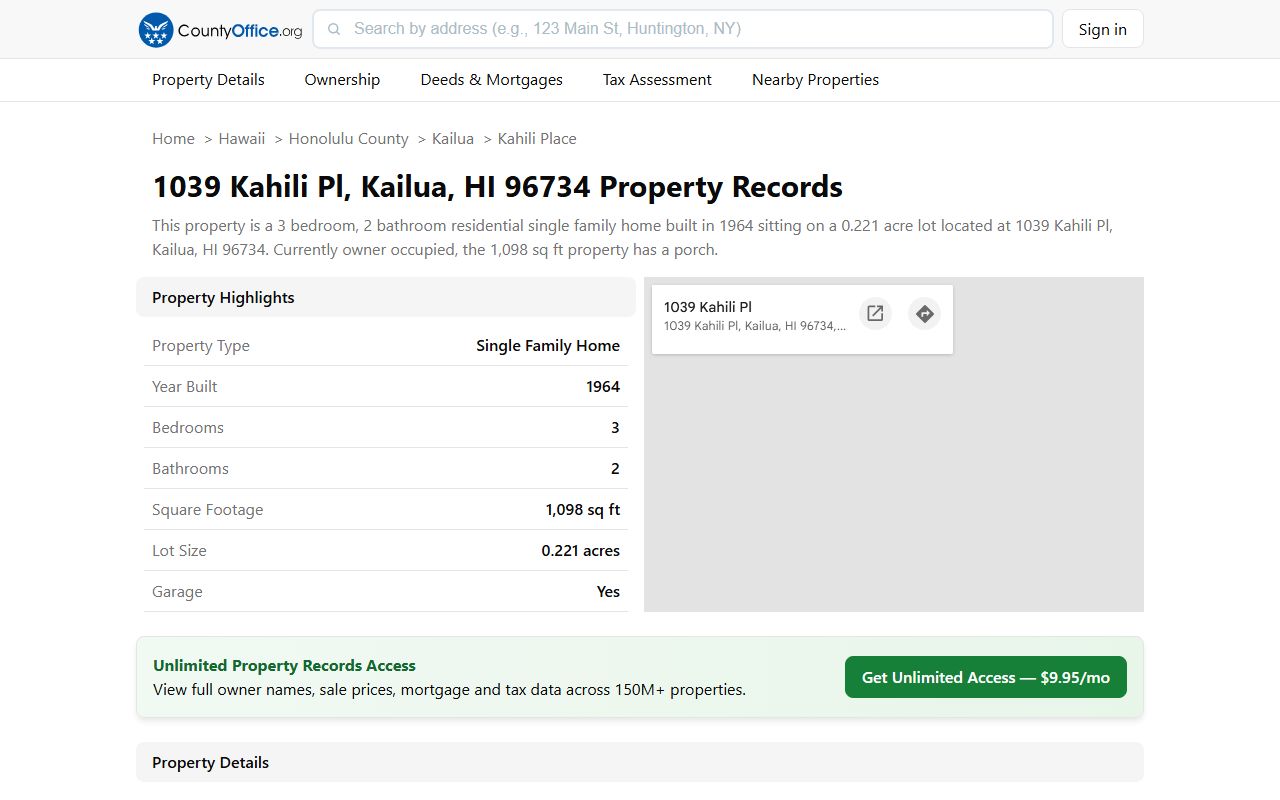
This Kahili Place record shows how Kailua assessments can reach well above $1.5 million for coastal and near-coastal properties, which is why the tax classification for these parcels matters so much.
Note: The qPublic database updates every Monday, so a property that sold in the past week may not yet show the new owner's name in the system.
Downtown RPAD Office Serves Kailua
Kailua sits on the windward (east) side of Oahu. The closest RPAD office is the downtown Honolulu branch at 842 Bethel Street, Basement, Honolulu, HI 96813. This is the primary office for windward Oahu communities including Kailua and Kaneohe. The phone number for both RPAD offices is (808) 768-3799.
The Kapolei branch at 1000 Uluohia Street, Suite 206, Kapolei, serves the west side of Oahu. While either office can handle your questions by phone, in-person visits for Kailua residents are generally faster at the downtown location given the geographic proximity.
Both offices handle the same functions: assessment reviews, exemption filings, appeal form submissions, and property record inquiries. The online services portal at realpropertyhonolulu.com handles first-time exemption filings online, so you may not need to visit in person for that task.
| Primary Office for Kailua | 842 Bethel St Basement, Honolulu, HI 96813 |
|---|---|
| Phone | (808) 768-3799 |
| Alternate Office | 1000 Uluohia St Suite 206, Kapolei, HI 96707 |
| County Page | Honolulu County Property Records |
| RPAD Main Site | realproperty.honolulu.gov |
Note: Both offices share a single phone line. Calls during peak times around the December assessment notice mailing and January appeal deadline may experience longer wait times.
Kailua Property Values and the Residential A Classification
Kailua property values are among the highest on Oahu. The median assessed value is approximately $1,452,600. A specific example from the county database: the parcel at 1039 Kahili Place carries an assessed value of $1,531,200 and an annual tax bill of $4,826.15. That level of assessed value places many Kailua properties in a higher tax classification tier.
Honolulu County uses a classification called Residential A for non-owner-occupied residential properties valued over $1 million. This classification applies to investment properties, second homes, and any property that does not have an active home exemption on file. Residential A uses a two-tier rate structure. Properties are taxed at $4.50 per $1,000 of assessed value up to $1 million (Tier 1), and then at $10.50 per $1,000 on the assessed value above $1 million (Tier 2).
This tiered structure can produce a significantly higher tax bill compared to the standard Residential rate for owner-occupants. For a property assessed at $1,531,200 without an exemption, the Residential A calculation would apply the lower rate to the first $1 million and the higher rate to the remaining $531,200. That math adds up quickly, which is one reason Kailua homeowners who qualify for and file the home exemption save a meaningful amount each year.
Standard Residential classification (owner-occupied with active exemption) gets the lower base rate with the exemption amount subtracted first. For most Kailua homeowners who live in their property, the difference between Residential and Residential A classification can be several thousand dollars per year.
Note: Whether a property is classified as Residential or Residential A depends on exemption status as of October 1. If you miss the September 30 exemption deadline, the Residential A rate may apply for the entire following tax year.
Home Exemption and Its Effect on Classification
The home exemption is the most important program for Kailua owner-occupants, not just because it reduces taxable value but because it determines tax classification. Filing a valid home exemption and meeting the residency requirements places the property in the Residential class rather than Residential A. That classification shift alone can lower the tax bill by thousands of dollars per year for higher-value Kailua homes.
The basic home exemption amount is $100,000 off the assessed value. Owners who are 65 or older get $140,000 off. To qualify, you must own the property, occupy it as your principal residence, and file a Hawaii resident income tax return (Form N-11). The exemption application form is E-8-10.3. The deadline is September 30 each year. First-time applicants can file online at realpropertyhonolulu.com.
Once the exemption is on file and active, it carries forward automatically each year. You do not refile annually. However, if your status changes, such as converting the home to a rental or changing your primary residence, you must notify the RPAD office. Continuing to claim the exemption on a property that no longer qualifies can result in back taxes and penalties.
The September 30 deadline is strict. There is no grace period and no late-filing option for most situations. If you buy a Kailua home and move in after October 1, the exemption takes effect the following tax year, not the current one. Plan ahead when purchasing.
For all exemption forms and current instructions, visit realproperty.honolulu.gov/tax-relief-and-forms/exemptions/exemption-forms.
Note: Filing the home exemption and meeting the N-11 requirement are both required. Having one without the other is not enough. RPAD can deny the exemption if the county income tax records don't match the exemption claim.
Vacation Rental Properties: Hotel/Resort Classification
Kailua is known for its beaches, and many properties in the area operate as short-term vacation rentals. Properties that are used as vacation rentals and classified by the county as such are placed in the Hotel/Resort category. This classification carries a higher tax rate than either Residential or Residential A.
The Hotel/Resort classification applies when the property use is determined to be transient accommodation rather than long-term residential use. This means that operating a vacation rental in Kailua can significantly increase your annual tax bill compared to a standard residential property at the same assessed value.
The county determines classification based on use as of October 1. If a property is operating as a short-term rental and has no active home exemption, it may be classified as Hotel/Resort during the next assessment cycle. Property owners who convert a home to vacation rental use and want to understand the tax impact should contact the RPAD office at (808) 768-3799 before making the change.
This is particularly relevant in Kailua because of the high assessed values in the area. At Hotel/Resort rates, a property assessed at $1.5 million can carry a tax bill far above what the same property would owe under Residential classification.
Note: Classification disputes related to Hotel/Resort versus Residential A can be grounds for a Board of Review appeal if the owner believes the classification is incorrect.
Assessment Appeals for Kailua Properties
Kailua property owners can appeal their assessments through the Board of Review. The county mails assessment notices by December 15. The appeal deadline is January 15. The form to file is BFS-RPA-M-8-12, available on the RPAD appeals page at realproperty.honolulu.gov/appeals/appeal-information.
For Kailua, appeals often center on market value disputes. Coastal and near-coastal properties can have wide swings in comparable sales data, and an assessment that is more than 10% above fair market value is a valid appeal ground. Owners appealing on this basis should gather recent sales data for comparable Kailua properties, ideally sales from the six to twelve months before the October 1 valuation date.
Appeals about classification are also common in Kailua. If a property was placed in Residential A when the owner believes it qualifies for Residential, or if a vacation rental classification seems incorrect, those can be raised before the Board as well. The appeal form covers classification disputes alongside value disputes.
You must keep paying taxes during an appeal. Taxes in Honolulu County are due August 20 and February 20. Stopping payment does not protect you during the appeal process and will result in penalties and interest.
| Assessment Notice | Mailed by December 15 |
|---|---|
| Appeal Deadline | January 15 |
| Appeal Form | BFS-RPA-M-8-12 |
| Appeal Body | Board of Review (independent of RPAD) |
| Common Kailua Grounds | Value over 10% above market; classification dispute |
| Tax Payment During Appeal | Must continue; refund issued if appeal succeeds |
Note: An informal review request to RPAD at (808) 768-3799 can sometimes resolve factual errors such as wrong square footage before a formal Board hearing is needed.
Bureau of Conveyances: Kailua Deeds and Documents
All deeds, mortgages, easements, and liens on Kailua properties are recorded at the Hawaii Bureau of Conveyances. The BOC is a state office, not a county office, so all Oahu recordings go to the same location regardless of whether the property is in Kailua, Honolulu, or anywhere else on the island.
The BOC office is at 1151 Punchbowl Street, Room 120, Honolulu, HI 96813. Phone is (808) 587-0147. Email is dlnr.bc.faq@hawaii.gov. Hours are Monday through Friday, 8:15 a.m. to 4:15 p.m. The main BOC website is at dlnr.hawaii.gov/boc.
The online search tool, RecordEASE, covers documents recorded from 1976 forward. Access it at bocdataext.hi.wcicloud.com. You can search by grantor name, grantee name, TMK number, or document number. Each page costs $1.00 to retrieve. Most Kailua parcels record in the Regular System, though some older or registered properties may have documents in the Land Court system as well. RecordEASE lets you search either or both.
The image below shows the Bureau of Conveyances website, which is where Kailua deeds and all recorded instruments for Hawaii property are filed and accessed.
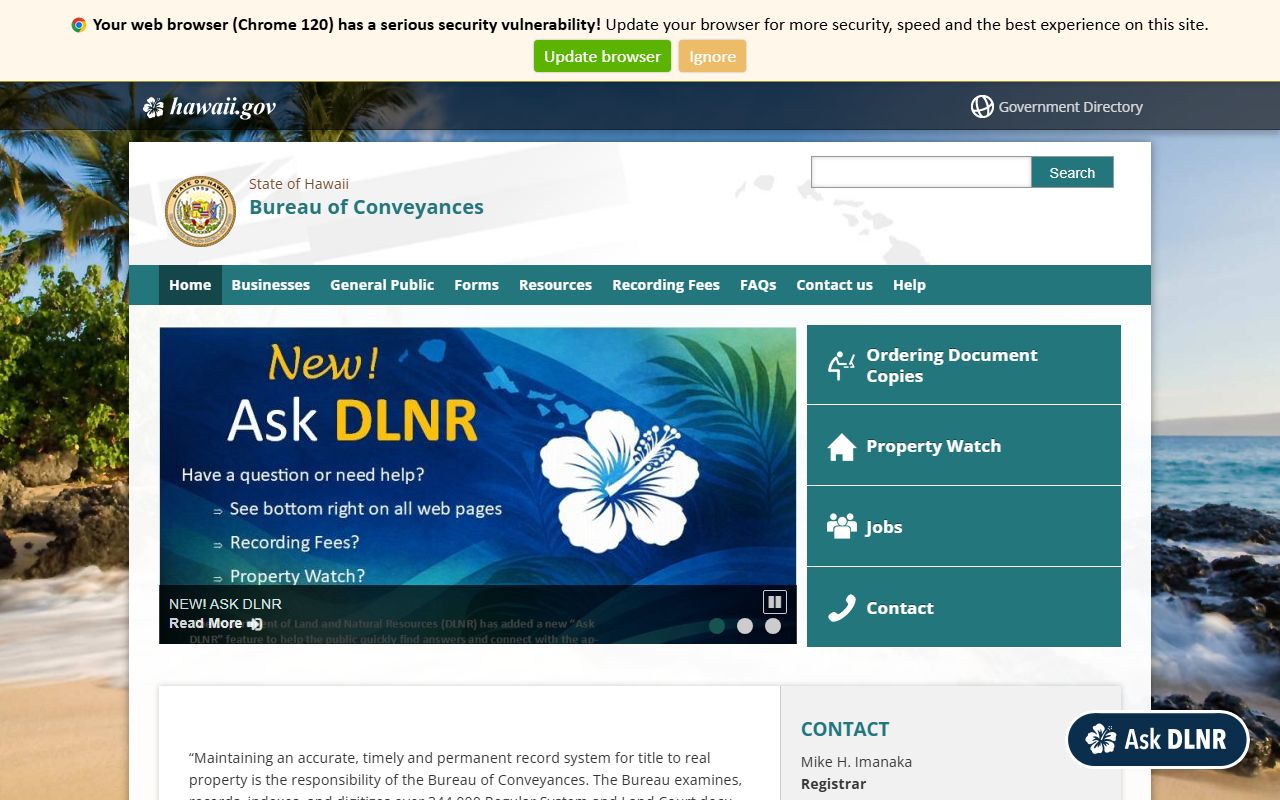
The BOC handles all property document recording for the state of Hawaii, including every deed and mortgage for Kailua parcels in both the Regular System and Land Court.
For court records tied to Kailua property, including foreclosure cases and lien enforcement actions, the First Circuit covers Oahu. Search those records through the Hawaii eCourt system at courts.state.hi.us.
Note: Documents recorded before 1976 are not available in RecordEASE. To research older Kailua title history, you must contact the BOC office directly or review physical microfilm records at the Punchbowl Street location.
Tax Payment and Online Access
Honolulu County bills property taxes twice a year. The first installment is due August 20. The second is due February 20. Pay online at pay.ehawaii.gov/hnl. The county also accepts payment by mail and in person at either RPAD office.
The online services portal at realpropertyhonolulu.com shows your current bill, active exemption status, and assessment detail. This portal is where first-time exemption applicants can file without visiting an office. It is separate from the qPublic search tool but draws from the same underlying county data.
For Kailua owners with Residential A classification, the online portal clearly shows which tier applies to what portion of the assessed value, so you can verify the calculation before payment is due.
Note: If you are unsure of your property's current classification, the qPublic portal shows the tax class field in the property detail view. Check it before each tax year to confirm nothing changed.
Nearby Hawaii Cities
Kailua is on the windward side of Oahu, with several neighboring communities that also fall under Honolulu County property records. The pages below cover the RPAD offices, search tools, and local classification rules for each of those cities.