
Hawaii County Property Records, Big Island
Hawaii County covers the entire Big Island of Hawaii, and its Real Property Tax Division maintains property records for every parcel across this vast landscape. If you need to search Hawaii County property records, whether for ownership details, assessed values, tax history, or exemption status, the county provides several online portals and two physical office locations to help you find what you need.
Hawaii County Overview
Hawaii County Property Records Search Tools
The county runs two main portals for property record searches. Most people start at hawaiipropertytax.com, the official Real Property Tax Division website. From there you can look up property details, download forms, read the Mass Appraisal Report, and learn about the Homeowner Program and other exemptions. It's the best place to start for most searches.
For direct parcel lookups, the county uses a qPublic search tool. You can search by location address, parcel number, legal information, or condo unit. Address searches use a specific format: enter the parcel prefix numbers first (like "95-5635"), then the street name (like "MAMALAHOA HIGHWAY"). Getting the format right matters. If your search turns up nothing, try entering just the street name without the prefix, or check the spelling carefully.
To pay property taxes online or look up payment history, the state operates a separate payment portal. Both portals pull from the same underlying parcel data maintained by the Real Property Tax Division.
The Real Property Tax Division website includes downloadable forms, exemption applications, and guides for new property owners. There is a dedicated "New Owner Information" section worth reading if you recently purchased land on the Big Island.
The county's real property tax portal makes it easy to look up current assessed values and tax class designations for any Big Island parcel. The screenshot below shows the main search interface at hawaiipropertytax.com.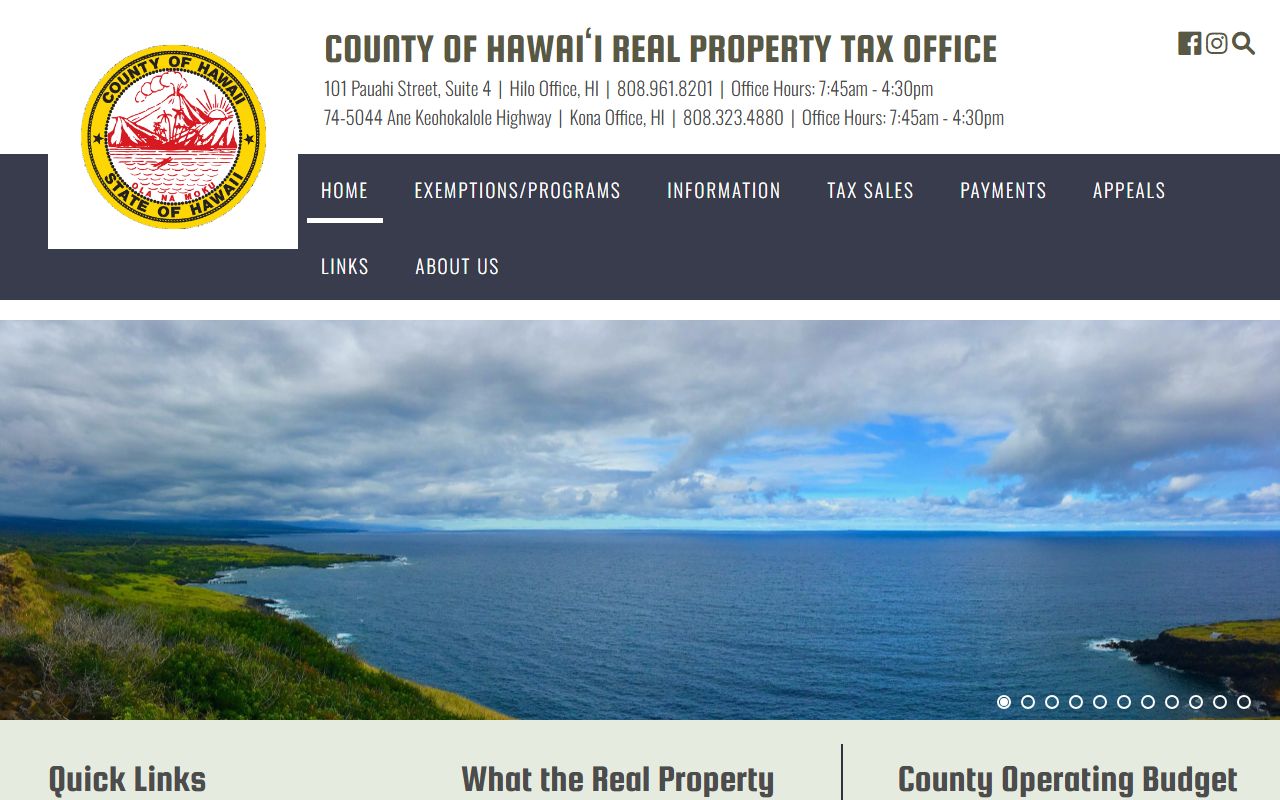 Records are updated after the Bureau of Conveyances processes new deeds, so recent sales may take some time to reflect the new owner's name.
Note: The qPublic search tool uses a specific address format, so entering the TMK prefix numbers before the street name will give you the most accurate results.
Hawaii County Real Property Tax Division Offices
Hawaii County is the largest county by land area in the entire United States. Because of that size, the Real Property Tax Division operates two separate offices, one in Hilo for East Hawaii and one in Kailua-Kona for West Hawaii. Both offices handle the same functions: assessments, exemption applications, name and address changes, and general property record questions. You can go to whichever office is closer to your property.
| East Hawaii Office (Hilo) | Aupuni Center, 101 Pauahi Street, Suite 4, Hilo, HI 96720 |
|---|---|
| Phone (East) | (808) 961-8201 |
| Fax (East) | (808) 961-8415 |
| West Hawaii Office (Kona) | 74-5044 Ane Keohokalole Highway, Building D, 2nd Floor, Kailua-Kona, HI 96740 |
| Phone (West) | (808) 323-4880 |
| Fax (West) | (808) 327-3538 |
| Office Hours | Monday through Friday, 7:45 AM to 4:30 PM |
| Division Administrator | Lisa Miura |
The division assesses all real property at fair market value as of January 1 each year. Staff process exemption applications, agricultural use dedication requests, and name or address changes after deeds are recorded. They do not set the tax rates. That job belongs to the Hawaii County Council, which sets rates each June based on the annual budget.
Hawaii County Property Assessment Key Dates
Hawaii County follows a set calendar each year for property assessments, billing, and exemption deadlines. Knowing these dates helps you file on time and avoid losing exemption benefits you may qualify for.
| January 1 | Real property valuation date; bills mailed for February 20 due date |
|---|---|
| March 15 | Assessment notices mailed to all property owners |
| April 9 | Last day to file an appeal of your assessment |
| June 20 | County Council sets tax rates for the coming year |
| June 30 | Deadline for Homeowner and Disability exemption applications; ownership changes affecting these must be recorded by this date |
| July 1 | Start of the tax year |
| July 20 | Bills mailed for August 20 due date |
| August 20 | First half taxes due |
| September 1 | Deadline for agricultural use dedication applications |
| September 30 | Deadline for Solar Water Heater credit |
| December 31 | Deadline for Homeowner, Disability, Affordable Rental, Kuleana, Community Food Sustainability, and most other exemption applications |
Missing the April 9 appeal deadline is a common problem. If your assessment notice arrives and the value seems wrong, you have a short window to act. Don't wait.
Note: Assessment notices go out March 15, giving property owners less than four weeks to review and file an appeal before the April 9 cutoff.
Hawaii County Homeowner Exemption
The Homeowner Exemption is the most common property tax benefit in Hawaii County. To qualify, you must own the property and use it as your principal home for more than 200 calendar days per year. "Principal home" means the place you truly live and intend to return to, not a vacation home or rental. If you rent any portion of the property for fewer than 180 days, you lose both the Homeowner tax class and the 3% assessment cap that comes with it.
Three things must be in place to get the exemption. First, your ownership must be recorded at the Bureau of Conveyances by December 31 for the first half bill, or by June 30 for the second half. If you bought through a lease, the lease must be at least 10 years long and recorded. Second, you must file RP Form 19-71 by the same deadlines. Third, you must have filed a State of Hawaii Resident Income Tax Return (Form N-11) within the last 12 months, or requested a waiver from the division. All three conditions must be met. Missing any one of them disqualifies the application for that period.
Hawaii County Property Tax Exemptions and Programs
Beyond the Homeowner Exemption, Hawaii County offers a range of other programs. Some are based on disability status. Others apply to specific types of land use or ownership. The county's exemptions page at hawaiipropertytax.com lists all current programs with forms and instructions.
Veterans with a disability rating between 80% and 100% from the VA may qualify for a full exemption from most property taxes. This requires filing both RP Form 19-77 and RP Form 19-87. Kuleana lands, which are small native land grants from the 19th century, also qualify for special exemption treatment. There are also programs for blind and deaf individuals, Hansen's Disease patients, affordable rental housing properties, non-profit organizations with 501(c)(3) status, and community food sustainability operations. Historical residential dedications are available for certain older homes as well.
The screenshot below shows the exemptions and programs section of the county's real property tax site, where you can download current application forms. Most exemption applications are due by December 31, but the Agricultural Use Dedication has its own September 1 deadline, and the Solar Water Heater credit must be filed by September 30.
Note: Veteran disability exemptions require both RP Form 19-77 and RP Form 19-87, and the VA disability rating must be between 80% and 100%.
Hawaii County Agricultural Use Dedication
The Agricultural Use Dedication program offers a significant tax break for working farms on the Big Island. Most farms that qualify file as "Orchard" dedication, which carries the lowest tax rate available under the program. To qualify, the operation must exceed $2,000 in annual farm income. Applications are due by September 1, and the county will inspect the property before the end of October to verify the land is in active agricultural use.
The application process has several steps. You enter the Tax Map Key (TMK) number, select the dedication term, fill in ownership information, complete Section 1 from the Farm Plan form, and include your most recent State GET Tax form G-49 or IRS Schedule F as proof of farm income. You also need to draw the farm boundary on a map and submit everything by the September 1 deadline. If the property is sold while under dedication, the new owner must continue the program or the seller is responsible for back taxes at the higher rate. The Kona Coffee Farmers Association maintains a helpful guide to this process at konacoffeefarmers.org.
The agricultural dedication program is especially relevant for coffee, macadamia nut, and other orchard crops common across the Big Island. This screenshot from the Kona Coffee Farmers site explains the program in plain terms.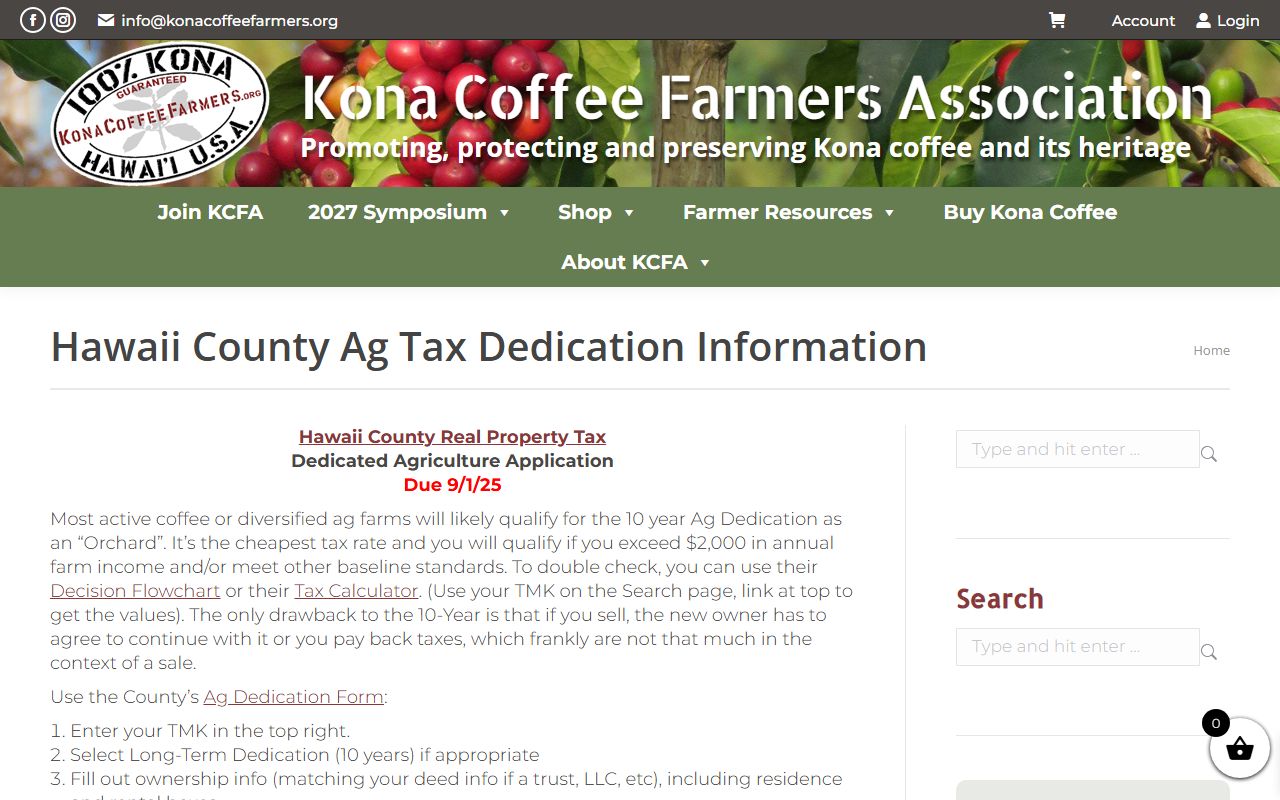 Farms that miss the September 1 deadline must wait until the following year to apply.
The county also offers a Native Forest Dedication for landowners who want to preserve or restore native forest. The land must be at least 3 acres, have at least 25% tree cover, and at least 60% of that cover must be native forest species. The dedication runs for 20 years and requires a forest management plan. The tax assessment under this program is the same as pasture land, which is among the lowest rates in the county.
Deed Recording and the Bureau of Conveyances
Hawaii is unusual in that all property deed recordings go through one statewide office: the Bureau of Conveyances, which is part of the Department of Land and Natural Resources. There is no county-level deed recording system. Every sale, transfer, mortgage, or lien on Big Island property must be filed with the Bureau in Honolulu.
You can search recorded documents through the Bureau's RecordEASE system at bocdataext.hi.wcicloud.com. This covers deeds, mortgages, liens, easements, and other instruments recorded statewide. After a deed is recorded, the Real Property Tax Division updates its records to reflect the new owner, but this takes some processing time. The governing statute for document recording is Hawaii Revised Statutes Chapter 502.
The Bureau of Conveyances main page is at dlnr.hawaii.gov/boc. From there you can learn about the Land Court system (for registered land) versus the Regular System (for non-registered land), which affects how searches work in RecordEASE.
Note: Hawaii uses two recording systems, Land Court and Regular System, and deeds recorded under one system do not appear in searches of the other.
Third Circuit Court Records
Property-related court matters on the Big Island, including foreclosure cases, quiet title actions, and tax appeals that go to court, are handled by the Third Circuit Court. The court covers Hawaii County and is part of the Hawaii State Judiciary. You can search court records and find contact information at the Hawaii State Judiciary website. Foreclosure actions, in particular, sometimes reveal useful information about a property's ownership and lien history that may not appear in the tax records alone.
Cities in Hawaii County
Hilo is the county seat and the largest city on the Big Island. It is served by the East Hawaii office of the Real Property Tax Division.
Other Hawaii Counties
Property records in Hawaii are managed at the county level. Each county runs its own Real Property Tax Division with separate assessment rolls and portals.