
Kihei Property Records Lookup
Kihei property records are maintained by Maui County's Real Property Assessment Division and can be searched online through the county's qPublic portal. Located on Maui's sunny South Shore with six miles of coastline, Kihei has a large concentration of condominiums, vacation rentals, and owner-occupied homes, which means property tax classifications vary widely from parcel to parcel. This guide explains how to find Kihei property records, understand the tax rate that applies to your parcel type, file for exemptions, and access recorded documents through state and county systems.
Kihei Overview
How to Search Kihei Property Records
The Maui County qPublic portal is the main tool for searching Kihei property records. It is free and does not require a login. Go to qpublic.schneidercorp.com and search by owner name, street address, or parcel number. Results show the current owner, mailing address, assessed land and improvement values, total assessed value, tax classification, any exemptions, and recent sales history.
Owner name searches require a specific format. Enter the last name, a comma, and then the first name. Search "GARCIA,CARLOS" not "Carlos Garcia." If you only know the last name, add a comma after it, like "GARCIA," and the system returns all owners with that surname in Maui County. Address searches work well with just a street number and a partial street name. Kihei has many condominium complexes, so searching by unit number in the address field can help narrow results when you need a specific unit's record. Parcel number searches use the Tax Map Key assigned to each Kihei lot or unit.
Maui County's property tax rate information is important for Kihei buyers and owners because the classification assigned to a parcel determines the rate.

Rate information like this helps Kihei property buyers calculate likely tax costs before purchase, since a condo used as a short-term rental pays more than six times the rate of an owner-occupied home.
Note: Always confirm your parcel's current classification in the qPublic portal, since misclassification in either direction can significantly affect your annual tax bill.
Kihei Property Tax Classifications
Kihei's mix of residential homes, condominiums, and vacation rentals means tax classification is one of the most important things to check when buying or owning property here. Maui County assigns each parcel a classification based on how it is used. The classification determines the rate you pay. Getting this right matters a lot in Kihei, where the gap between the lowest and highest rates is enormous.
Owner-occupied properties pay on a tiered scale. The first $1,000,000 of assessed value is taxed at $1.90 per $1,000. The next $2,000,000 (from $1M to $3M) is taxed at $2.00 per $1,000. Any value above $3,000,000 is taxed at $2.75 per $1,000. Most Kihei owner-occupants pay primarily at the $1.90 tier. Short-term vacation rentals and hotel/resort-classified properties pay $11.85 per $1,000 of assessed value. That rate applies to Kihei condos and homes advertised on short-term rental platforms like VRBO or Airbnb without a long-term lease. Non-owner-occupied residential properties that are not short-term rentals fall into a separate classification with a rate between these two extremes. Agricultural, conservation, commercial, industrial, and time-share classifications each have their own rates as well.
If you own a Kihei condo and are unsure which classification applies, search your TMK on qPublic and look at the tax classification field in the results. If the classification does not match how you are using the property, contact the Clerical unit at (808) 270-7871 to start a reclassification review.
Note: Properties that shift from short-term to long-term rental use may qualify for reclassification, but the change requires both an updated filing with the RPA Division and the December 31 deadline applies for the next tax year.
RPA Division Office
Kihei property owners are served by the Maui County Real Property Assessment Division office in Kahului, about 15 to 20 minutes north of Kihei depending on traffic. The address is 70 E. Kaahumanu Avenue, Suite A-16, Kahului, HI 96732. This is the office where you file exemption applications, get tax map copies, and resolve classification or assessment questions. For most routine matters, you can handle things by phone or email without making the drive.
| Clerical (exemptions, mailing, land class) | (808) 270-7871 |
|---|---|
| Compliance (ag use, dedication) | (808) 270-7295 |
| Tax Maps (ownership, new TMKs, map orders) | (808) 270-7226 |
| Appraisal (property values) | (808) 270-7798 |
| Appraisal Email | RPA@co.maui.hi.us |
| Tax Bills / Circuit Breaker | (808) 270-7697 |
| Tax Bill Email | Maui.rptc@co.maui.hi.us |
| Phone Payment | 1-833-312-0151 |
Tax bill questions go to the tax collection contact. Assessed value questions go to Appraisal. Exemption filings and mailing address updates go to Clerical. The RPA Division main page and the Tax Fee Collection page cover payment options, due dates, and delinquency information for Kihei properties.
Note: Kihei property owners can make phone payments using the automated line at 1-833-312-0151, which is useful if you want to pay without driving to Kahului or navigating the county website.
Home Exemption for Kihei Homeowners
If you live in your Kihei property as your primary home, you may qualify for the Maui County Home Exemption. The exemption reduces your assessed value by $200,000 for tax purposes. On a property assessed at $800,000, you would only pay tax on $600,000. At the Tier 1 owner-occupied rate of $1.90 per $1,000, that saves $380 per year compared to paying on the full assessed value.
Qualification requires filing Hawaii state income tax Form N-11 as a resident for at least two consecutive years. Your ownership must be recorded at the Bureau of Conveyances by December 31 of the year before you want the exemption to take effect. Only individuals and trusts qualify. Corporations and LLCs do not. The exemption stays in place automatically once granted. You do not need to refile each year unless your residency, ownership structure, or use of the property changes.
File your application by December 31. Forms are available on the RPA Forms and Instructions page. Submit to the Clerical unit at the Kahului office. If you recently bought a Kihei home and the prior owner had an exemption, you must file your own new application. The exemption does not transfer automatically when a property sells.
Note: A Kihei condo that qualifies as owner-occupied gets both the lower tax rate and the $200,000 exemption, so getting the classification and exemption right together has a significant financial impact.
Long-Term Rental Exemption
Kihei has a significant number of properties used as short-term vacation rentals. The county's Long-Term Rental Exemption is designed partly to encourage owners to shift toward stable, long-term housing. If you rent your Kihei property under a signed lease of 12 months or more, you may qualify for an exemption of up to $200,000 off your assessed value. The property must be current on all taxes. You must file by December 31 and include a copy of the signed lease with your application.
The financial difference between classifications can be significant for Kihei property owners. A property classified as a short-term vacation rental pays $11.85 per $1,000 of assessed value. A property with a long-term lease on file may qualify for a lower classification and the $200,000 exemption on top of that. For a Kihei condo assessed at $700,000, the difference between the short-term rental rate and the long-term rental rate can amount to thousands of dollars per year. Owners who are open to long-term tenants should talk to the Clerical unit at (808) 270-7871 to understand exactly what they need to file and what timeline applies.
A Kihei owner who lives in one property and rents a second under a long-term lease can claim the Home Exemption on the primary residence and the Long-Term Rental Exemption on the rental parcel. These are separate exemptions and can be applied to separate parcels at the same time.
Note: The Long-Term Rental Exemption must be refiled each year with a current signed lease; it does not carry forward automatically the way the Home Exemption does.
Assessment Appeals
Kihei property owners who disagree with their assessed value can appeal to the Board of Review. Maui County mails assessment notices in mid-March each year. The 2026 notices were mailed on March 13. The appeal deadline is April 9. You must file before that date or wait until the following year.
A strong appeal brings supporting evidence. A recent independent appraisal of the Kihei property is the most useful document. Comparable sales from similar properties in the same area also help. If the county's records show errors in the property description, like the wrong square footage or an improvement that does not exist, document those errors clearly. The Appraisal unit at (808) 270-7798 can tell you what the board expects to see. Track your appeal status through the Maui County real property tax site, which includes an appeal tracker tool.
Note: Tax payments remain due during a pending appeal; do not delay payment while waiting for a hearing or you may incur penalties regardless of the appeal outcome.
Public Documents and Recorded Instruments
The Maui County public documents portal at publicweb1.co.maui.hi.us lets you search county-recorded documents by TMK number. Use wildcard characters to broaden your search. Enter *234 to find all TMK numbers ending in 234, or 234* to find all starting with 234. This is useful when you are researching a Kihei condo project and want to find all parcels in a specific development.
The county documents portal covers instruments filed at the county level. Most deeds, mortgages, and liens are recorded at the state level through the Hawaii Bureau of Conveyances. For a complete picture of a Kihei property's recorded history, use both the county portal and the state RecordEASE system.
The qPublic portal search tool is the starting point for most Kihei parcel lookups, and the image below shows what the search interface looks like before you enter your query.
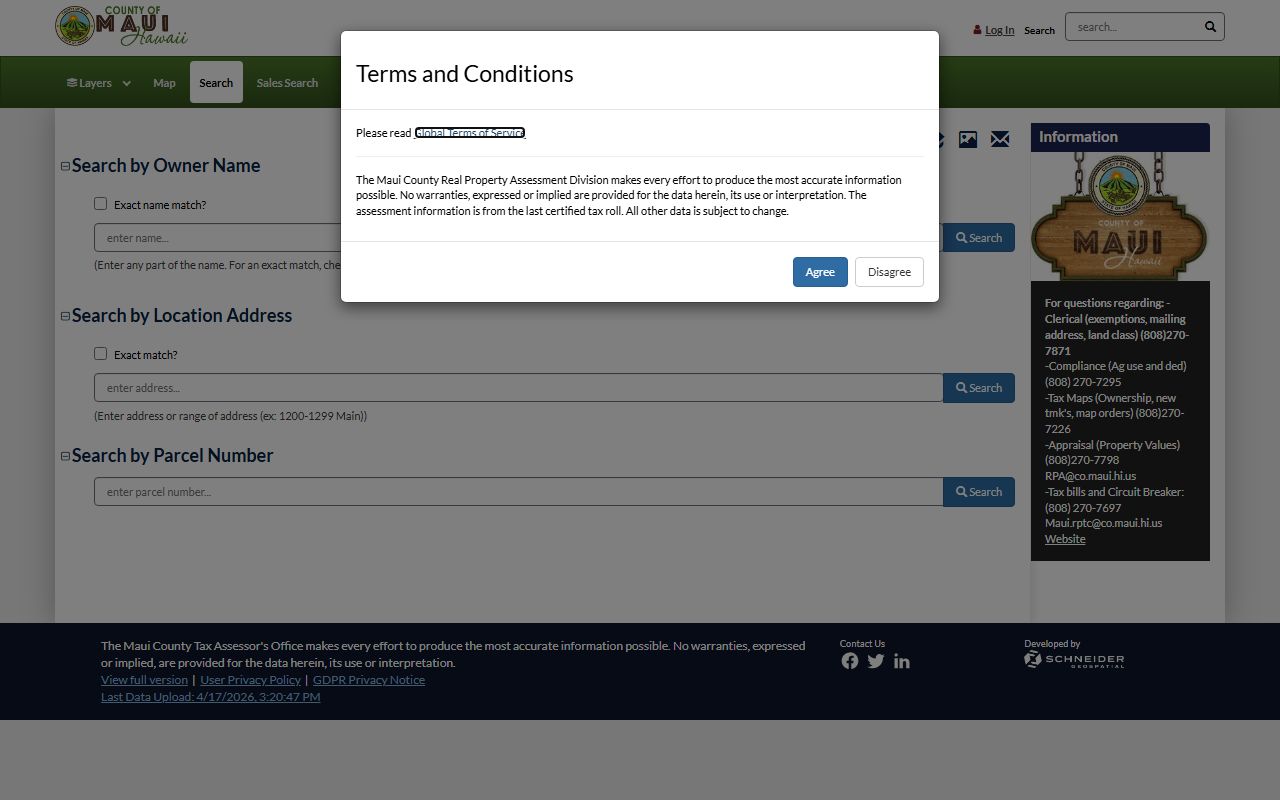
The search portal lets you look up any Kihei parcel by owner name, address, or TMK and see its full assessment record without a login or fee.
Note: Kihei condo units have individual TMK numbers separate from the common areas of the project; search for the specific unit number to get the correct parcel record.
Bureau of Conveyances
The Hawaii Bureau of Conveyances records all property documents statewide, including deeds, mortgages, releases, and liens for Kihei properties. The bureau is part of the state Department of Land and Natural Resources. Its office is at 1151 Punchbowl Street, Room 120, Honolulu, HI 96813, and the phone is (808) 587-0147. The website is at dlnr.hawaii.gov/boc.
Use RecordEASE at bocdataext.hi.wcicloud.com to search by owner name, TMK, or document number. Document images cost $1 per page. For a Kihei condo, a title search typically starts with the unit's TMK and works back through recorded deeds to establish the chain of ownership. If you are buying a Kihei property and want to check for liens or encumbrances, a title company will do this search through RecordEASE as part of the closing process. If you are doing your own research, start with the current deed and grantor/grantee index entries.
Second Circuit Court covers Maui County. Court records related to Kihei properties, including foreclosure cases, can be found through Hawaii eCourt at courts.state.hi.us. For county-wide property record information, visit the Maui County property records page.
Note: Kihei properties sometimes carry recorded easements tied to coastal access or utility corridors; a full title search through RecordEASE is the best way to identify any such encumbrances before purchase.
Nearby Hawaii Cities
Kahului and Wailuku are the nearest major Maui cities to Kihei, each with its own property records page.