
East Honolulu Property Records
East Honolulu property records cover parcels across Kahala, Hawaii Kai, Aina Haina, Waialae Iki, Niu Valley, and surrounding neighborhoods on the southeast side of Oahu. These records are maintained by the Honolulu Real Property Assessment Division and include assessed value, ownership, tax classification, and sale history for every parcel. You can search East Honolulu property records online using qPublic or the county GIS map tool. This page walks through both search methods and covers the key factors that affect how East Honolulu properties are classified and taxed, including the Residential A rules that apply to many high-value parcels in this area.
East Honolulu Overview
How to Find East Honolulu Property Records
Two online tools cover East Honolulu property records. The first is qPublic, which is the main assessment search portal for all of Honolulu County. The second is the county GIS map search, which lets you locate parcels visually on a map before pulling up the record. Both tools pull from the same assessment database and show the same core data. Which one you use depends on what you already know. If you have an address or TMK, qPublic is faster. If you are not sure of the exact address or want to see boundary lines and surrounding parcels, the GIS tool is better.
Access qPublic at qpublic.net/hi/honolulu. Search by property address, owner name, or Tax Map Key. For address searches, enter the street number in the first field and the street name in the second. If the parcel covers a range of addresses, use dashes in the number. Results show TMK, property class, land area, owner name and mailing address, land value, building value, total assessed value, exemptions, tax rate, and tax amount. Prior sale dates and amounts also appear at the bottom of each record.
The GIS map search is at qpublic.schneidercorp.com. It shows parcel boundaries, zoning, and aerial imagery across East Honolulu. Click a parcel on the map to bring up its full record. This is useful for understanding lot size, shape, and relationship to neighboring properties. Assessment data in both tools is updated annually on December 15. The Monday weekly refresh handles mid-year changes to ownership and corrections.
The Honolulu County GIS parcel map lets you search East Honolulu properties by clicking directly on a map, with parcel boundaries and zoning visible.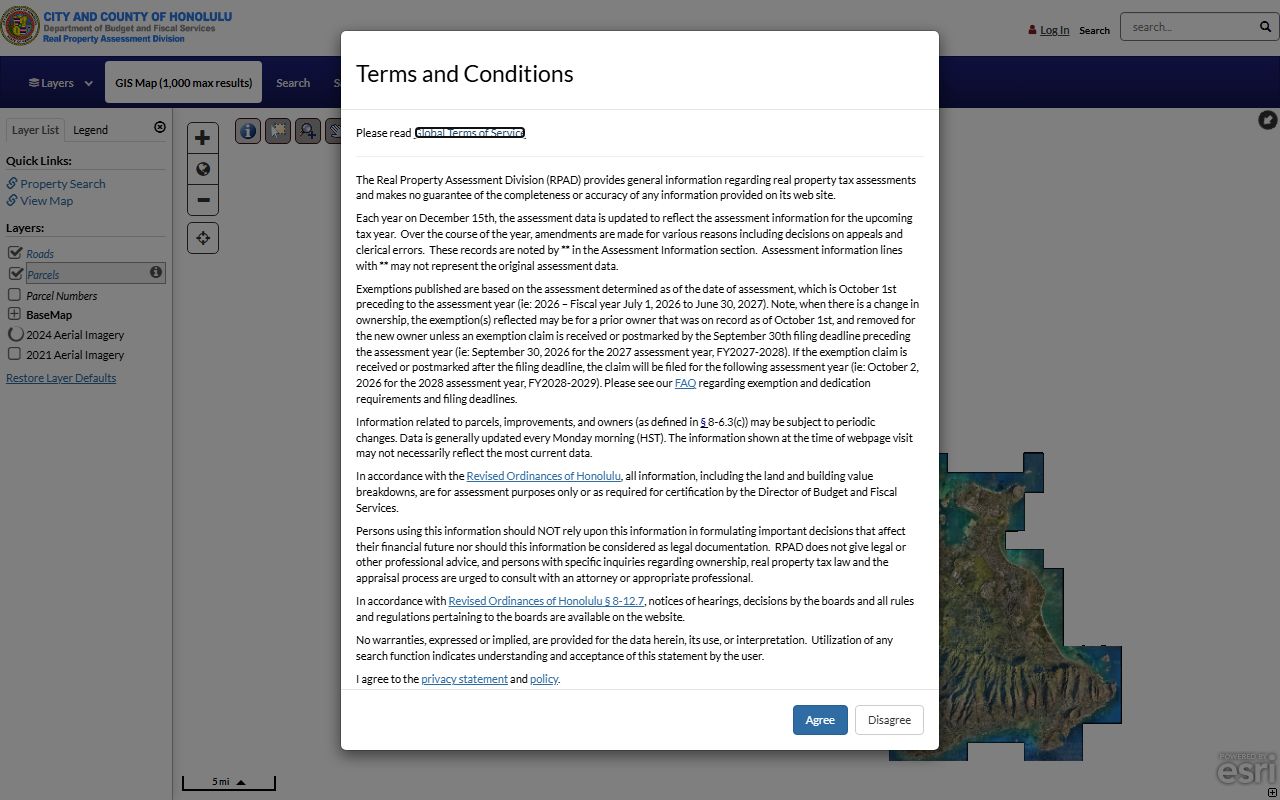
The GIS tool is especially useful for East Honolulu's hillside and coastal neighborhoods where lot shapes and addresses can be hard to match from memory alone.
RPAD Office and Services for East Honolulu
East Honolulu property records are managed by the Honolulu Real Property Assessment Division. RPAD handles assessment, exemptions, tax maps, and ownership records for every parcel in the county, including all East Honolulu neighborhoods. The downtown Honolulu office on Bethel Street is the primary location for East Honolulu residents. Walk-in service is available on weekdays. Staff can answer questions about your assessment notice, help with exemption applications, and explain the appeal process.
| Address | 842 Bethel Street, Basement, Honolulu, HI 96813 |
|---|---|
| Phone | (808) 768-3799 |
| Hours | Monday through Friday, 7:45 AM to 4:30 PM |
| RPAD Website | realproperty.honolulu.gov |
| Online Services | realpropertyhonolulu.com |
RPAD has 111 employees total. The Assessment Branch uses mass appraisal methods approved by the International Association of Assessing Officers to value all parcels each year. The Mapping Branch maintains tax maps and ownership records. Both branches serve East Honolulu as part of the countywide operation.
The Honolulu Real Property Assessment Division provides assessment and tax services for East Honolulu property owners through its downtown office and online portal.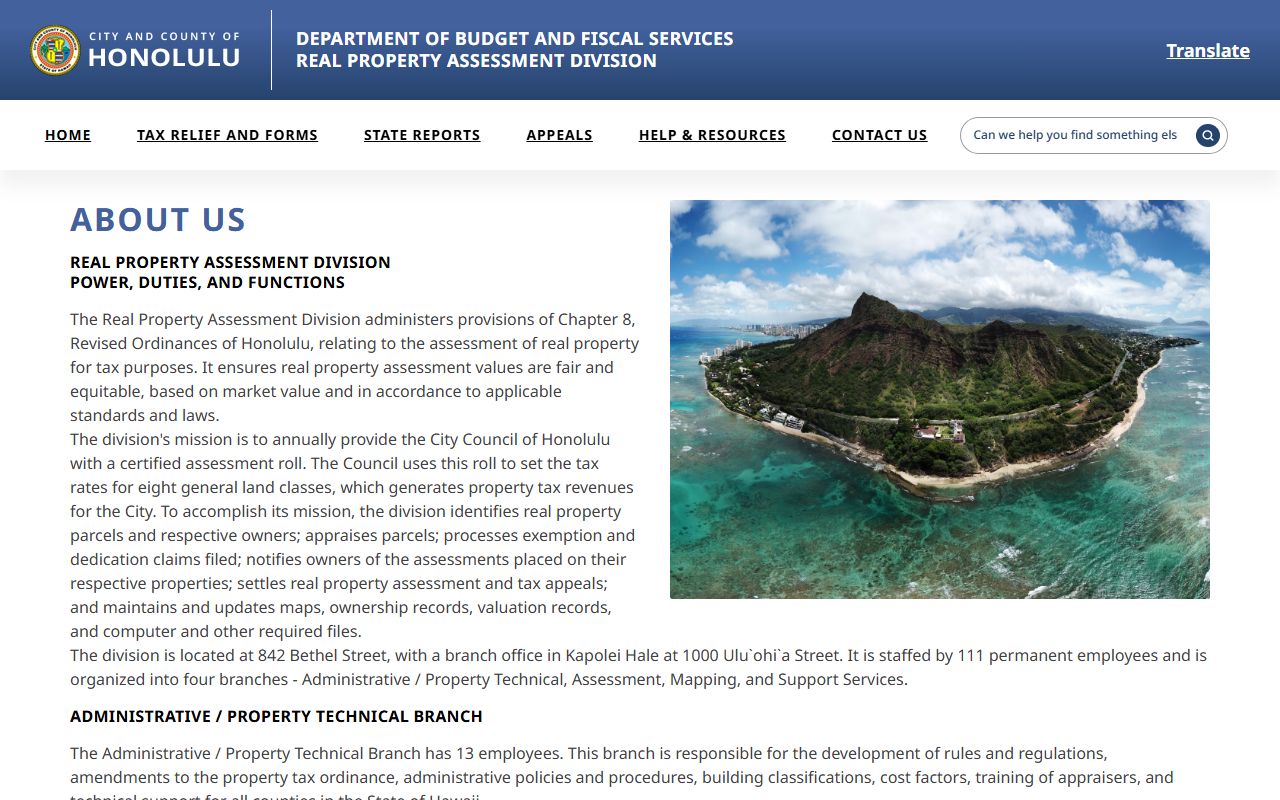
The RPAD about page outlines the division's structure, staff, and the standards used to appraise East Honolulu parcels each year.
Note: For a full overview of Honolulu County property records resources, visit the Honolulu County property records page.
Residential A Classification in East Honolulu
Residential A is a property tax classification that applies specifically to residential parcels with a total assessed value over $1,000,000 that do not qualify for the home exemption. This classification matters a lot in East Honolulu because property values in Kahala, Hawaii Kai, Waialae Iki, and Niu Valley are among the highest on Oahu. A large share of East Honolulu parcels are owned as investment properties, second homes, or vacation rentals and do not receive a home exemption. Those properties, if assessed above $1,000,000, fall into Residential A.
The Residential A rate has two tiers. The first tier covers the portion of assessed value up to $1,000,000 and is taxed at $4.50 per $1,000 of assessed value. The second tier applies to the portion above $1,000,000 and is taxed at $10.50 per $1,000. Both tiers apply to the same property. For example, a parcel assessed at $1,531,200 with no exemption would be taxed as follows: $4.50 per $1,000 on the first $1,000,000, plus $10.50 per $1,000 on the remaining $531,200. The resulting tax bill would be roughly $4,500 plus $5,577, or about $10,077 per year before any credits. The median assessed value for East Honolulu area parcels runs around $1,452,600, which puts many in the Tier 2 range.
In contrast, owner-occupied homes that qualify for the home exemption are classified as plain Residential, which has a lower single rate and is applied after the exemption reduces the taxable value. If you own an East Honolulu property and live in it as your primary home, getting the exemption correctly applied is the most important step you can take to reduce your annual tax bill. Without the exemption, you pay more and may be misclassified as Residential A when you should be Residential.
One common issue in East Honolulu is properties changing ownership and losing their exemption without the new owner realizing it. When a property sells, any existing exemption is removed and must be refiled by the new owner. If you bought an East Honolulu home recently and have not filed for the home exemption, you are likely paying at the Residential A rate even if you live there full time. The fix is to file Form E-8-10.3 before September 30.
Home Exemption for East Honolulu Homeowners
East Honolulu owner-occupants can apply for the home exemption to get the lower Residential tax classification. The basic exemption is $100,000 off the assessed value. Owners who are 65 or older qualify for a larger exemption of $140,000. You must own and live in the property as your principal home to qualify. Investment properties, vacation homes, and rentals do not qualify, even if you visit them regularly.
The deadline to file is September 30 each year. The exemption then applies to the following tax year. You can file online for the first time at realpropertyhonolulu.com using the unique ID on your assessment notice or tax bill. Once approved, the exemption renews automatically each year as long as your status does not change. If you sell or move out, you must tell RPAD so the exemption is removed. Leaving an exemption on a property you no longer occupy is a violation and can result in penalties and back taxes.
For East Honolulu property owners who rent out their home, the exemption does not apply. If total assessed value exceeds $1,000,000, the Residential A rate kicks in. This affects many Kahala and Hawaii Kai properties used as long-term or short-term rentals.
Appealing Your East Honolulu Assessment
East Honolulu property owners who believe their assessed value is too high can file an appeal. RPAD mails assessment notices on December 15 each year. The window to appeal closes January 15, just 31 days later. Do not wait to review your notice. If the value looks significantly off compared to what similar homes in East Honolulu have sold for recently, start gathering evidence right away.
Appeals go to the Board of Review. File Form BFS-RPA-M-8-12 by the January 15 deadline. You can file online through realpropertyhonolulu.com using the unique ID from your assessment notice, or mail a paper form to RPAD. The appeal form asks for your parcel information and the grounds for the appeal. Valid grounds include the assessed value exceeding the property's market value by 10% or more, unequal treatment relative to comparable parcels, a denied exemption you believe you qualify for, or an error in the legal process of the assessment. The assessed value carries a legal presumption of correctness. You must show evidence that it is wrong. Comparable sales data, a recent independent appraisal, or a listing price well below the assessed value are the most common forms of evidence used in East Honolulu appeals.
The RPAD appeal filing portal allows East Honolulu property owners to submit assessment appeals online or download the required form for paper filing.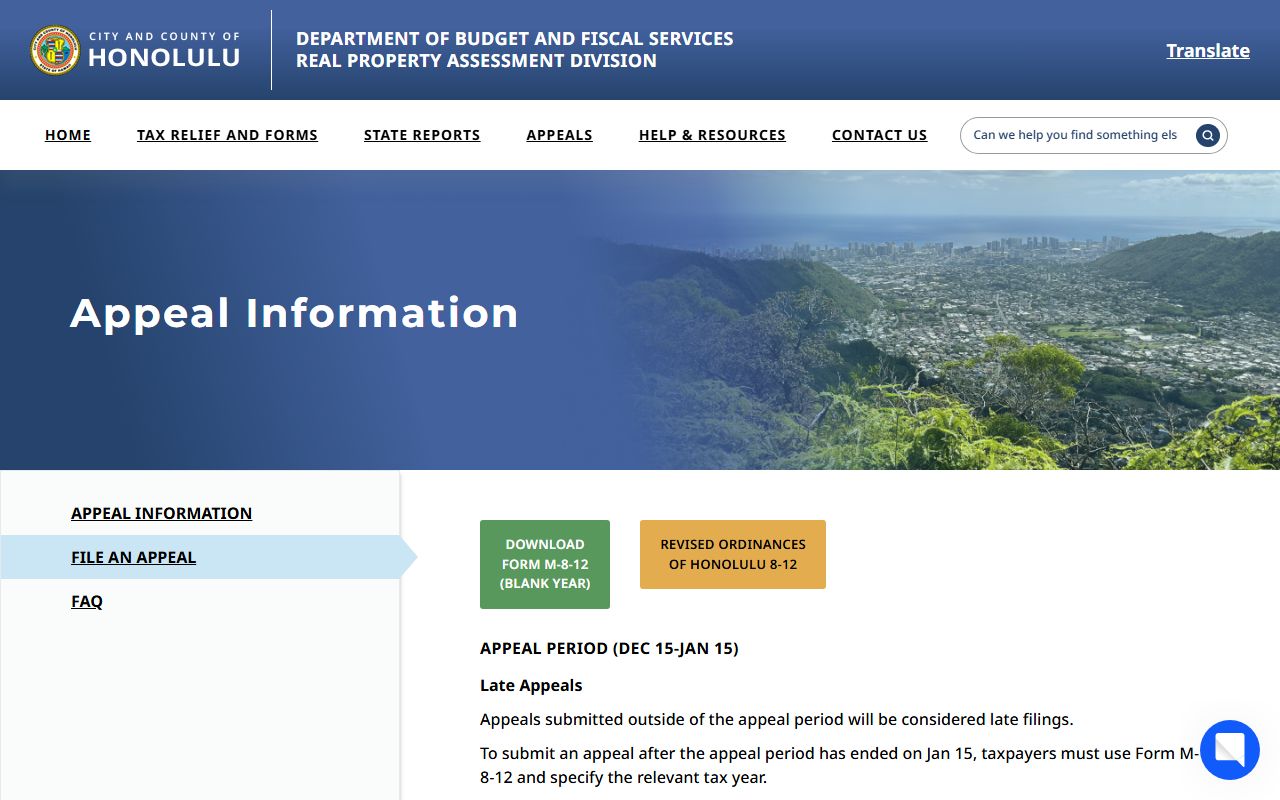
The appeal page includes instructions, deadlines, the downloadable form, and a link to the online filing system for East Honolulu parcels.
Note: Tax payments for East Honolulu parcels are due August 20 for the first half and February 20 for the second half, payable online at pay.ehawaii.gov/hnl using your 16-digit parcel ID.
Deed and Title Records for East Honolulu
Recorded deeds, mortgages, easements, and liens for East Honolulu parcels are filed with the Hawaii Bureau of Conveyances, not with RPAD. The Bureau is a statewide office that records all real property documents across every island. It is located in downtown Honolulu at 1151 Punchbowl Street and maintains records going back to the territorial period.
For documents recorded since 1976, use the RecordEASE online index at bocdataext.hi.wcicloud.com. You can search by grantor name, grantee name, TMK, or document number. The system shows each document's type, recording date, and parties. Viewing the full document costs $1 per page for credit card transactions. Creating a prepaid account offers a lower rate. For documents predating 1976, you must visit the Public Reference Room in the Kalanimoku Building at Room 123 in Honolulu. Staff there can help locate older title chains for East Honolulu properties with long ownership histories.
| Bureau of Conveyances | dlnr.hawaii.gov/boc |
|---|---|
| Address | 1151 Punchbowl Street, Room 120, Honolulu, HI 96813 |
| Phone | (808) 587-0147 |
| RecordEASE | bocdataext.hi.wcicloud.com |
Some East Honolulu properties, particularly in older parts of Kahala and Hawaii Kai, may have both land court and regular system records. If you are researching a parcel's full title history, check both the land court index and the general conveyances index in RecordEASE.
Court Records for East Honolulu Property Cases
East Honolulu is part of the First Judicial Circuit, which covers all of Oahu. Property-related court matters, including land court filings, quiet title actions, and probate cases involving real property, are heard in First Circuit Court. The main courthouse is at 777 Punchbowl Street in downtown Honolulu.
You can search First Circuit court records online at no cost through eCourt Kokua at courts.state.hi.us. The system covers civil cases, land court, and probate. Search by party name or case number to find filings and hearing schedules tied to East Honolulu parcels. Many Hawaii properties have land court records that go back decades and show every registered transaction on the parcel. Land court certificates of title carry stronger legal protection than general system deeds, and those records are maintained through the court system rather than the Bureau of Conveyances.
For certified copies of court documents, contact the First Circuit clerk. Fees apply for certified copies and vary by document type. In-person requests are processed at the courthouse. Some records may also be available through eCourt for direct download.
Online Services and Tax Payment for East Honolulu
RPAD's online portal at realpropertyhonolulu.com handles most common tasks for East Honolulu property owners. You can file or renew a home exemption, submit an appeal using your notice's unique ID, update your mailing address, sign up for email delivery of assessment notices, and remove an exemption. The site confirms each submission on screen. Save or print the confirmation for your records.
Tax payments go through a separate portal at pay.ehawaii.gov/hnl. You need the 16-digit parcel ID from your tax bill. Credit card payments carry a service fee. Bank account payments via ACH are typically lower cost. The portal shows the current balance due and lets you pay one or both installments at once. The first-half tax bill for East Honolulu parcels is due August 20. The second-half is due February 20.
Nearby Hawaii Cities
Other major Oahu cities near East Honolulu with their own property record pages are listed below.